Wave absorber
Model: CA02-2020-1000
Applications
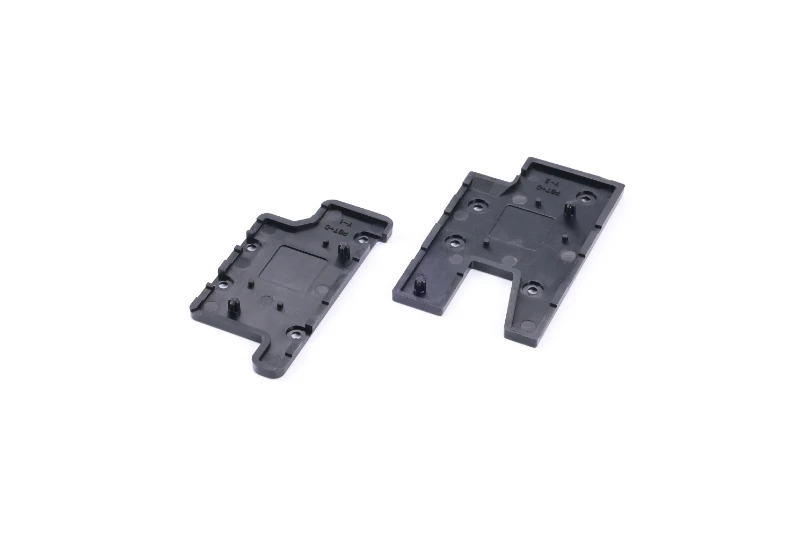
Description
The main body of CA02-2020-1000 absorber is made of black glass fiber reinforced PBT material (PBT+G), which possesses excellent mechanical strength and dimensional stability. The product strictly adheres to RoHS 2.0 environmental standards, with no surface treatment, deburring, or grease contamination, and the inside is engraved with the cavity number, material, and date stamp. It is suitable for electronic component scenarios that have strict requirements for cleanliness, precision tolerances, and electromagnetic compatibility.
Features
- PBT insulating plastic, resistant to high temperatures, with small molding shrinkage, suitable for supporting and fixing electronic components.
- The combination of four corner mounting holes and a central positioning hole ensures precise assembly alignment and prevents deviation.
- The flatness of the entire board is 0.2, to avoid warping during assembly and poor fit.
- Unified fillets, chamfers, and VDI24 fine texture, without shrinkage, burrs, or material deficiency defects.
- Inscribed on the inner side, with flat and even characters
Specifications
Whitepapers
Features
- PBT insulating plastic, resistant to high temperatures, with small molding shrinkage, suitable for supporting and fixing electronic components.
- The combination of four corner mounting holes and a central positioning hole ensures precise assembly alignment and prevents deviation.
- The flatness of the entire board is 0.2, to avoid warping during assembly and poor fit.
- Unified fillets, chamfers, and VDI24 fine texture, without shrinkage, burrs, or material deficiency defects.
- Inscribed on the inner side, with flat and even characters
Specifications
Wave absorber
Model: CA02-2020-1000
Applications
Description
The main body of CA02-2020-1000 absorber is made of black glass fiber reinforced PBT material (PBT+G), which possesses excellent mechanical strength and dimensional stability. The product strictly adheres to RoHS 2.0 environmental standards, with no surface treatment, deburring, or grease contamination, and the inside is engraved with the cavity number, material, and date stamp. It is suitable for electronic component scenarios that have strict requirements for cleanliness, precision tolerances, and electromagnetic compatibility.
Whitepapers

Related Solutions

Complete structural solution for 4D imaging millimeter-wave radar
The vehicular millimeter-wave radar, installed at the front of the vehicle, must withstand vibrations from driving, exposure to wind, sand, rain, and snow, while also strictly controlling electromagnetic interference. Shell deformation and insufficient wave absorption performance can directly lead to inaccurate radar ranging and angle measurement, resulting in false alarms and missed detections. Many suppliers can only provide single components, requiring customers to integrate from multiple suppliers, which incurs high coordination costs.

Automotive EPS (Electric Power Steering) System Connection Solution
With the popularization of intelligent driving, the EPS steering electronic control signals have become increasingly complex. Vehicle vibration during driving, alternating high and low temperatures, and contamination from engine compartment water and gasoline can easily cause poor contact and signal disconnection of connectors, posing significant safety hazards to driving. Traditional universal connectors struggle to meet the stringent safety requirements for in-vehicle applications.